Learning how to cast a fly rod is easier than it looks. Most of it comes down to three things: a short, crisp stroke, a firm stop, and a pause that lets the line straighten. Get those right and the rod does most of the work.
This guide covers fly fishing casting for beginners, step by step: the grip, the overhead cast, timing, loop control and false casting. You’ll also see the most common fly casting mistakes and how to fix each one.
Grip and Stance
Grip. Hold the cork like a handshake, with your thumb on top of the grip pointing at the rod tip. Keep it firm but relaxed. You only need to squeeze hard at the moment you stop the rod.
Line hand. Your other hand holds the fly line below the first guide. It keeps the line tight so the rod can load. More on this below.
Stance. Stand with your feet about shoulder-width apart. If you cast right-handed, put your right foot slightly back. This lets you turn your head and watch your back cast, which is the fastest way to learn.
Start with 20 to 30 feet of line. That’s enough line outside the rod tip to bend the rod, but not so much that it gets hard to control. Not sure your rod is the right fit? See Why the Right Rod Matters.
The Basic Casting Stroke: Think of a Clock
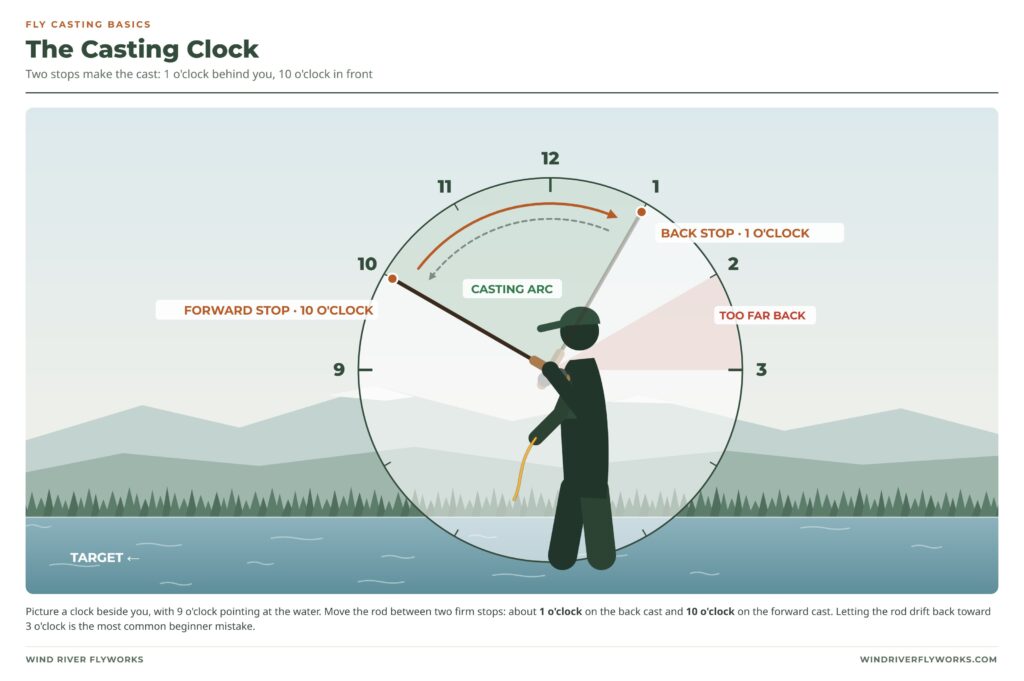
Picture a clock face beside you, with 12 o’clock straight overhead and 9 o’clock pointing at the water in front of you. A basic overhead cast moves the rod between two stops:
- Back cast: stop the rod at about 1 o’clock, just past straight up.
- Forward cast: stop the rod at about 10 o’clock, pointing a little above the water.
The stop is what makes the cast. Moving the rod bends (loads) it. Stopping it sharply unbends it and sends the line in the direction the tip was moving. A soft stop, or no stop at all, lets the energy leak out and the line piles up.
Keep the stroke short. For 20 to 30 feet of line, the rod only travels between 10 and 1. As you cast farther, the stroke gets longer and the stops move wider.
The Overhead Cast, Step by Step
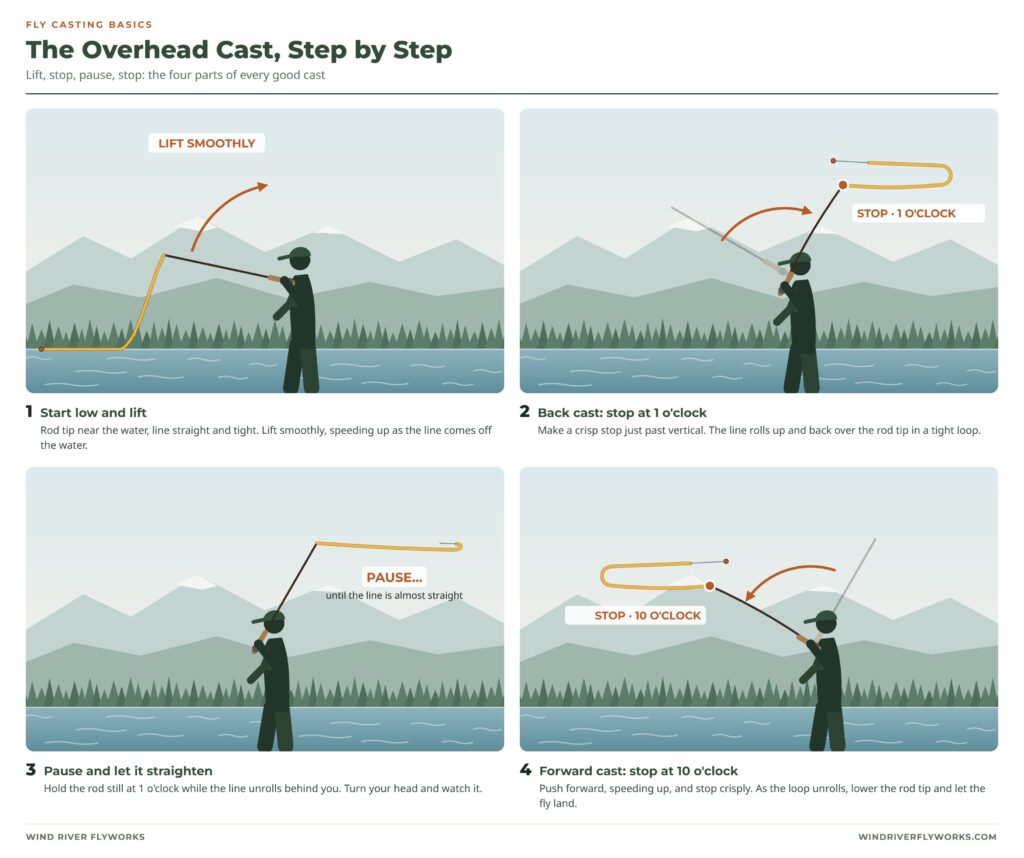
The overhead cast is the foundation of every other cast. Here it is in five steps.
- Start low. Point the rod tip at the water, with the line straight in front of you. Remove all slack with your line hand.
- Lift and sweep back. Raise the rod smoothly, speeding up as you go, to lift the line off the water.
- Stop at 1 o’clock. Make a crisp stop just past vertical. The line shoots up and back over the rod tip.
- Pause. Wait while the line unrolls behind you. When it’s almost straight, start forward.
- Cast forward and stop at 10 o’clock. Push forward, speeding up, then stop crisply. Let the line unroll and lower the rod tip as the fly lands.
Timing and the Pause
Timing is where most beginners struggle. After each stop, the line needs time to unroll and straighten before you change direction.
- Start forward too early and you crack the line like a whip. That can snap off your fly.
- Wait too long and the line drops behind you, often into the grass or water.
The right pause depends on how much line is out. More line takes longer to straighten. The easiest way to learn the timing is to turn your head and watch the back cast. Start forward the moment the line is almost straight, just as you feel a gentle tug on the rod.
Loops and Line Control
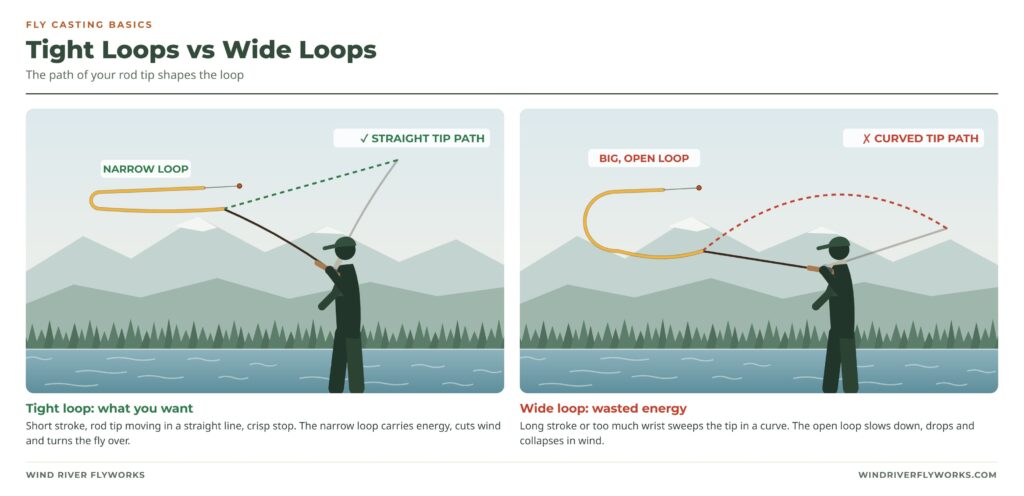
Watch your line in the air and you’ll see it form a U-shaped loop as it unrolls. The shape of that loop tells you how well you’re casting.
- Tight loop: a narrow U. Your rod tip traveled in a straight line and you stopped crisply. Tight loops cut through wind and carry the fly farther.
- Wide loop: a big, open U. Your rod tip swept in a curve, usually because your stroke was too long or you rotated your wrist too much. Wide loops lose energy and collapse in wind.
Use your line hand. Keep the line pinched in your free hand the whole time. If the line slips, slack creeps in, the rod can’t load, and the cast falls apart. When you’re ready to add distance, let a little line slide through your fingers on the forward cast. This is called shooting line.
False Casting
A false cast is a forward cast that you don’t let land. You make a back cast, a forward cast, and then another back cast before the line touches the water. False casting helps you:
- Let out more line, a few feet at a time, to reach farther.
- Dry off a wet dry fly so it floats.
- Change direction to aim at a new target.
Keep it to two or three false casts. Each one is a chance for a mistake, and fish can spook from line waving overhead. Make the same 10 and 1 stops as a normal cast, and let the line straighten on both ends.
Common Fly Casting Mistakes and How to Fix Them
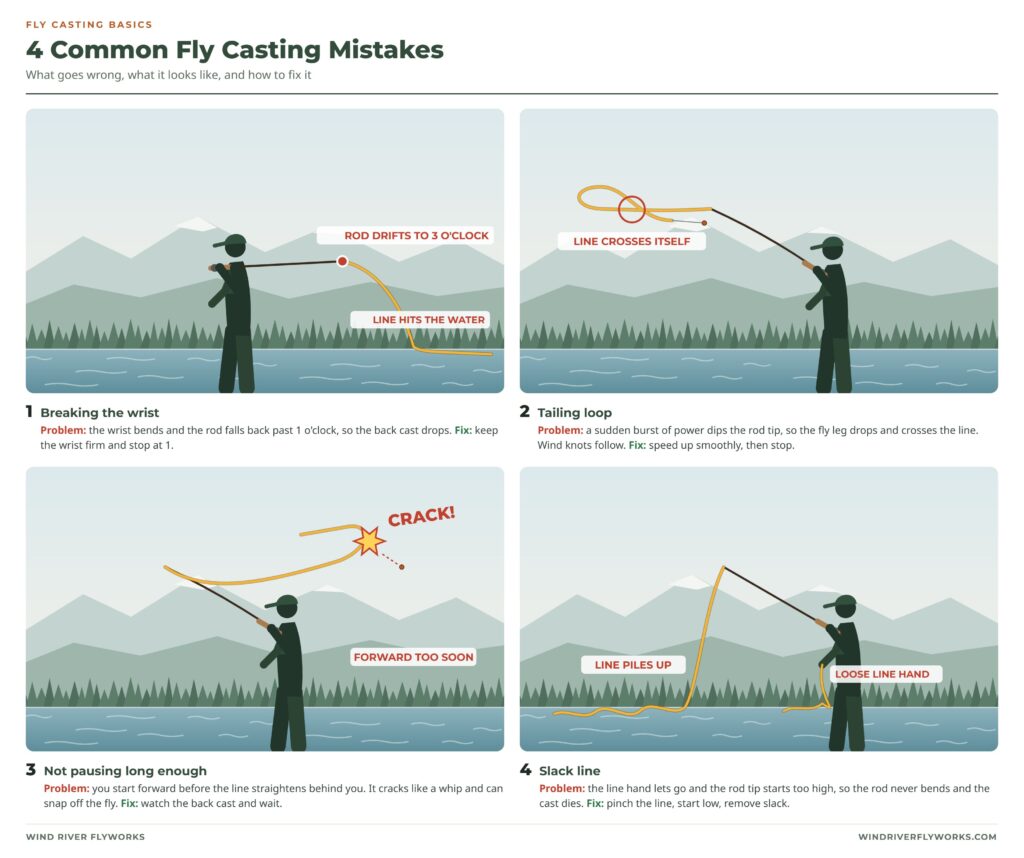
| Mistake | What you see | The fix |
| Breaking the wrist | Rod drifts back past 2 or 3 o’clock, line drops behind you | Keep your wrist firm. Some anglers tuck the rod butt against the forearm while practicing. |
| Too much power | Line cracks like a whip, flies snap off | Smooth acceleration, not a hard punch. Speed up gradually and stop crisply. |
| No pause | Line cracks on the back cast, cast collapses | Wait until the line is nearly straight behind you before going forward. |
| Tailing loop | Line crosses itself, knots form in the leader | Apply power smoothly instead of all at once at the start of the stroke. |
| Wide loops | Line unrolls in a big open U, dies in wind | Shorten the stroke and move the rod tip in a straight line. |
| Slack line | Rod doesn’t bend, cast has no power | Keep the line tight in your line hand. Start each cast with the rod tip low. |
Practice Drills for Beginners
Ten minutes in the yard is worth an hour of frustration on the river. Tie a short piece of bright yarn to the end of your leader instead of a fly.
- Grass casting. Lay 25 feet of line straight on the lawn. Make one back cast and one forward cast, then let it land. Check that it lands straight.
- Watch the back cast. Turn your head and watch the line unroll behind you. Start forward only when it’s nearly straight.
- Target practice. Set a paper plate 25 to 30 feet away and try to land the yarn on it. Move it farther as you improve.
- Sideways cast. Hold the rod out to the side, nearly flat. You can watch both loops in front of you, which makes timing easy to see.
- Short sessions. Practice for 10 to 15 minutes at a time. Stop when you get tired, before bad habits creep in.
Get Out and Cast
Every good caster started with piles of line at their feet. Keep the stroke short, stop crisply at 10 and 1, and pause long enough for the line to straighten. With a few practice sessions, you’ll be landing flies where you aim them.
Once your casting is dialed, you’ll need a good knot to tie on your fly. See our guide to 7 essential fly fishing knots.
Shop This Article
Stickers and gear that go with this guide, drawn by Nick and printed in the USA.
-
Trout Series Fishing Gloves
$17.99 Select options This product has multiple variants. The options may be chosen on the product page