If you could only carry one dry fly, a lot of experienced anglers would pick the Adams. It doesn’t copy any one insect exactly. Instead, its gray body, mixed brown and grizzly hackle and upright wings look a little like dozens of mayflies, caddis and even midge clusters. That’s exactly why it works almost everywhere trout rise.
This guide covers where the Adams came from, what each part of the fly does, the popular versions you’ll find in fly shops, how to pick the right size and how to fish it.
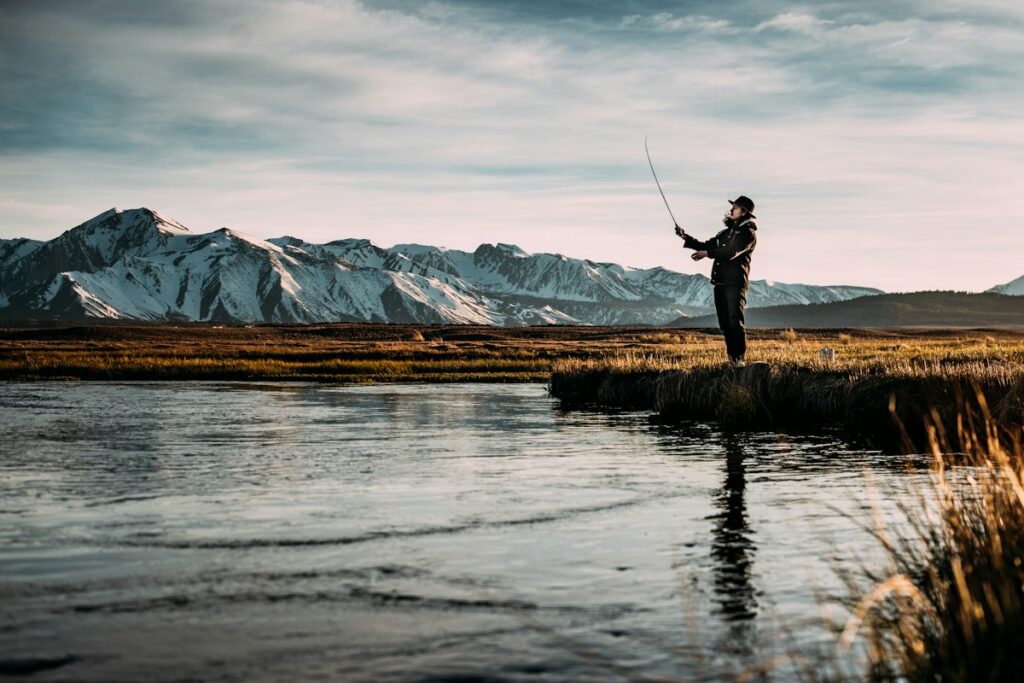
Evening on the river, when an Adams on the water is hard to beat. Photo: Robson Hatsukami Morgan on Unsplash.
A Little History
The Adams was first tied in 1922 by Leonard Halladay, a fly tier from Mayfield, Michigan. His friend Charles F. Adams, an attorney from Ohio, tried the new fly on the Boardman River near Traverse City and came back with a great report. Halladay named the fly after him, and a century later it’s still one of the best-selling dry flies in the world.
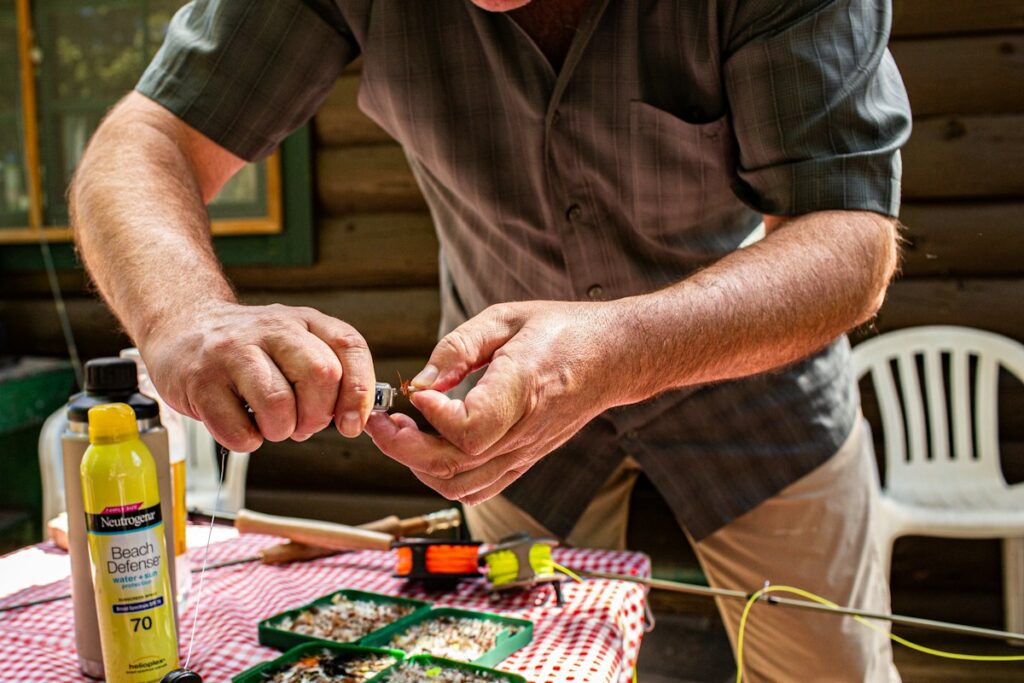
The Adams is also one of the first dry flies many tiers learn. Photo: Josh Frenette on Unsplash.
Anatomy of the Adams
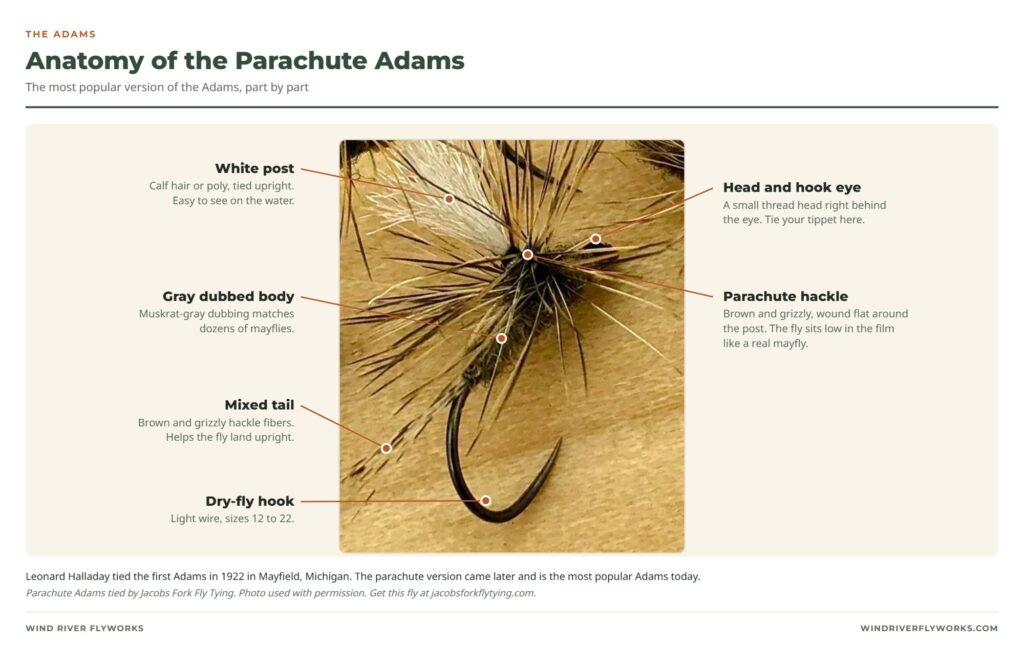
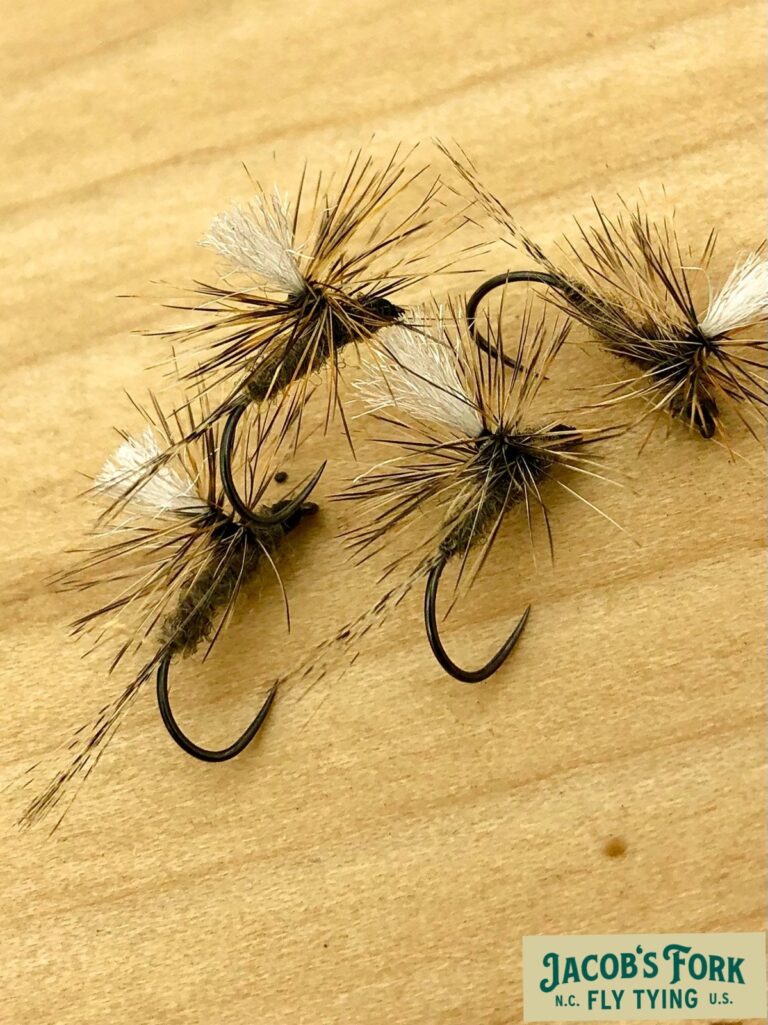
Every part of the Adams has a job. Together they make a fly that floats well, lands upright and looks like food to a trout. Here are the parts on a real Parachute Adams, the version most anglers fish today.
Tail: mixed brown and grizzly hackle fibers. They help the fly land and ride upright, like the tails of a mayfly.
Body: gray dubbing, originally muskrat fur. Gray is the color of a huge number of mayflies, caddis and midges.
Wings or post: the classic Adams has grizzly hen hackle tips, set upright and split, for the silhouette of a mayfly at rest. The Parachute Adams swaps them for a single white post that is much easier to see on the water.
Hackle: brown and grizzly hackle wound together as a collar. The mix of colors suggests legs and movement, and the stiff fibers hold the fly up on the surface. On the parachute version the hackle is wound flat around the post, so the fly rides low in the film like a real mayfly.
Why the Adams Works
Trout eat what’s common and easy, and they look first at size, shape and how a bug sits on the water. The Adams gets those right without matching any single insect too closely:
The right shape. Upright wings and a slim body read as “mayfly” to a trout.
The right colors. Gray and brown are the colors of most of the bugs on most rivers.
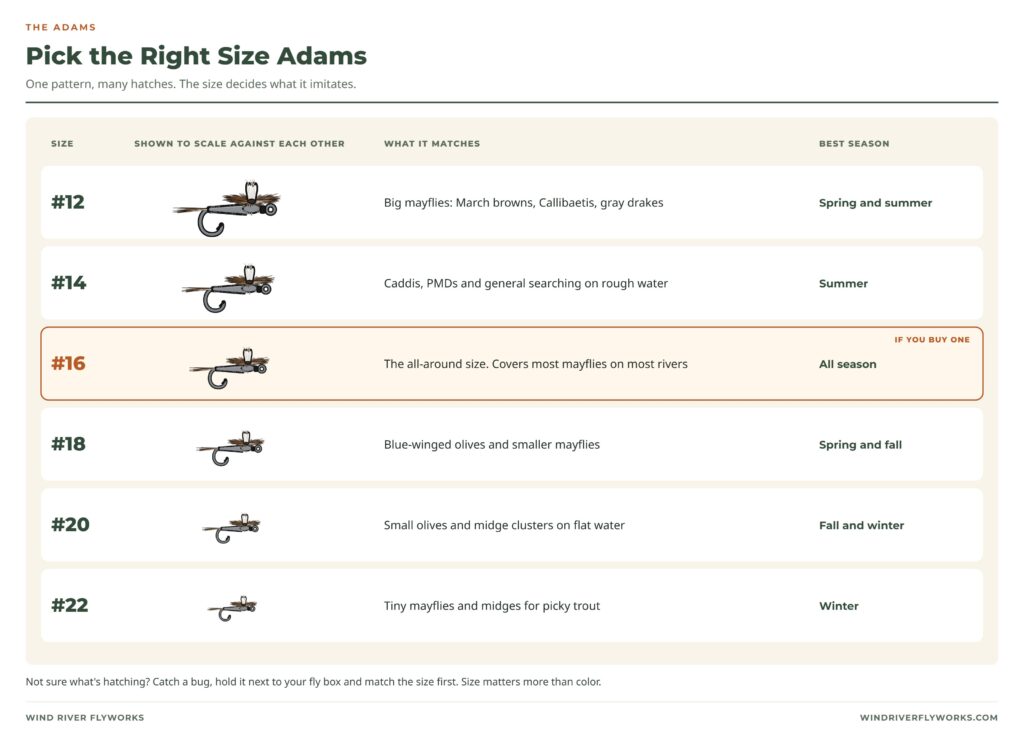
The right size. Tied from size 12 to size 22, it covers big spring mayflies down to winter midges.
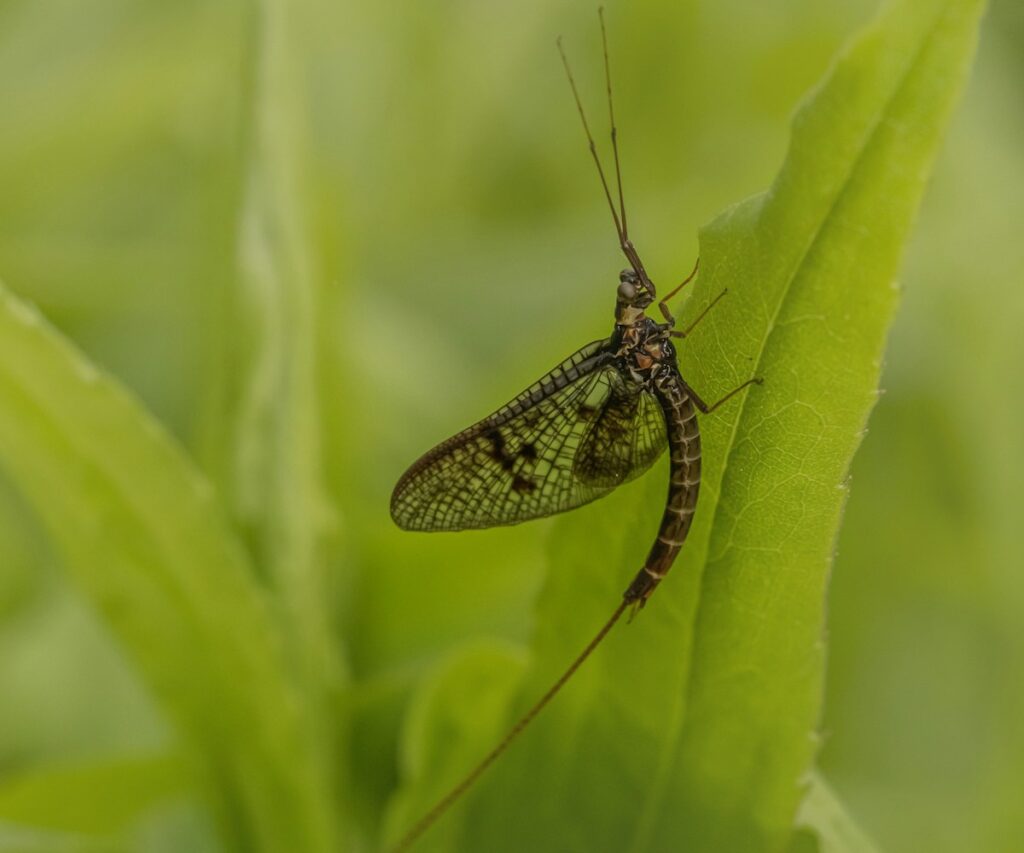
A mayfly at rest. Compare its upright wings and long tails to the Adams. Photo: Erik Karits on Unsplash.
The Adams Family
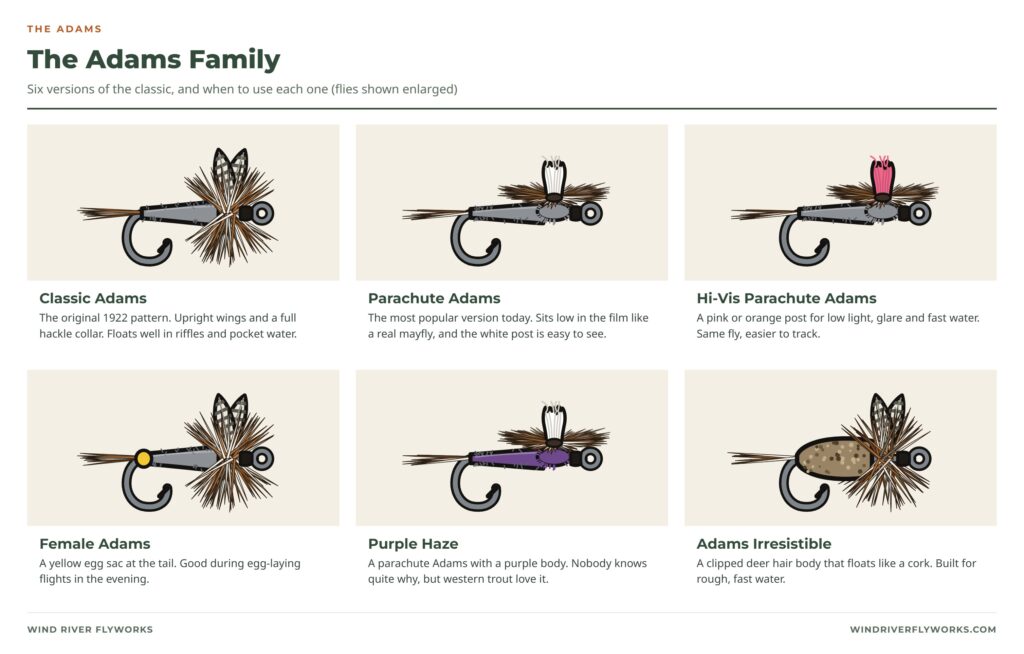
Over the years tiers have built a whole family of flies on the original. These are the versions we keep in our boxes and when we use them.
If you’re only buying one, buy the Parachute Adams. It sits lower in the surface film like a real mayfly, it lands upright almost every time and the white post is easy to see. Carry a hi-vis version for low light and choppy water.
How to Pick the Right Size
The size of your Adams decides what it imitates. When trout are rising, catch a bug or look at the ones on the water and match the size first. When nothing is hatching, a size 14 or 16 is a great searching fly.
Dead drift. Cast a few feet upstream of a rising fish or a likely spot and let the fly float with no drag. Mend your line to keep it drifting naturally.
Searching the water. No rises? Fish an Adams through riffles, seams and along banks. Trout will come up for a fly that looks like food even when nothing is hatching.
As an indicator. A size 12 or 14 Parachute Adams floats well enough to hold up a small nymph in a dry-dropper rig. You fish two depths at once and the post shows every take.
As a midge or BWO. In sizes 18 to 22, a Parachute Adams passes for small blue-winged olives and midge clusters on calm water. See Midges and Small Flies for more.
Tippet. Use 4X or 5X for sizes 12 to 16, and 6X for size 18 and smaller.
Keep Your Adams Floating
Treat the fly with floatant before you start fishing, not after it’s wet.
After a fish, rinse the fly, squeeze it dry in a cloth or chamois and false cast a few times.
Add a desiccant powder when the hackle gets slimy and the fly starts to sink.