Walk up to any trout stream and it can look like one long ribbon of moving water. Experienced anglers see something different: a riffle, a seam, a soft pocket behind a rock, a dark undercut bank. Reading the water is simply learning to see those pieces, and knowing which fly and which cast fits each one.
This guide is the hands-on companion to our How to Read a River for Trout article. Here we focus on what to look for when you’re standing on the bank, the surface clues that tell you what’s under the water, and how to work a piece of water so you don’t spook the fish before your fly gets there.
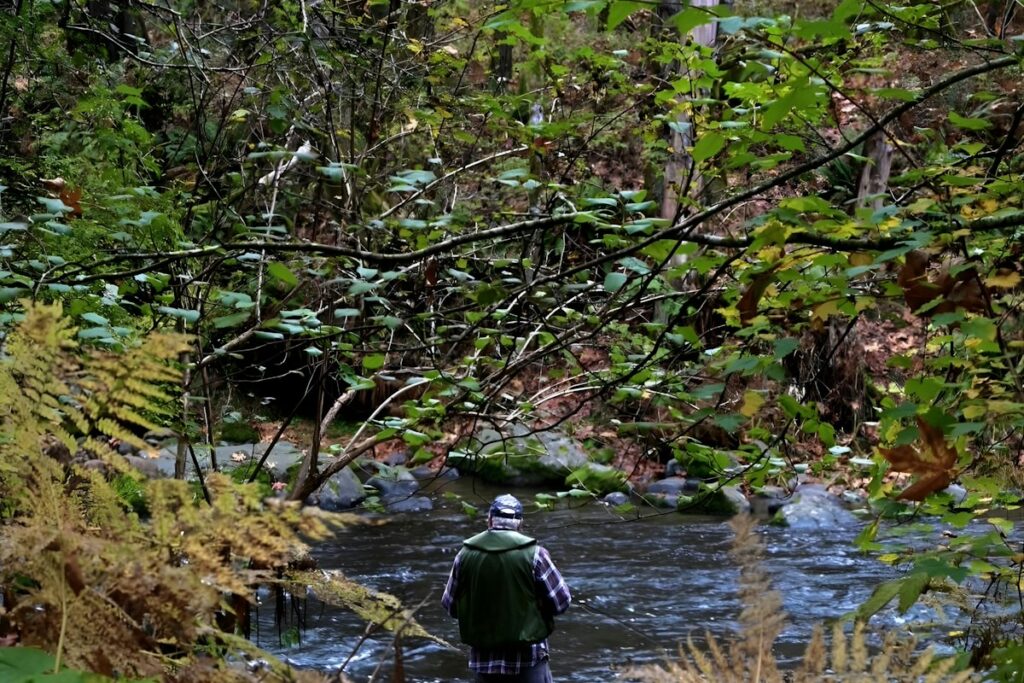
Before you cast, take a minute to study the water in front of you. Photo: K Atkinson on Unsplash.
Stop and Look Before You Cast
The best thing you can do when you reach the water is nothing. Stand back from the edge, keep a low profile, and spend two or three minutes just watching. You’ll be surprised how much you see.
Look for rises. Rings on the surface mean fish are feeding on top. Note the spot, because a feeding trout usually rises again in the same place.
Look for bugs. Check the air, the surface and the streamside brush. A quick look tells you what size and color fly to tie on.
Follow the current. Watch where the bubbles and foam travel. That’s where drifting food goes, and where trout wait for it.
Wear polarized sunglasses. They cut the glare off the surface so you can see rocks, ledges and sometimes the fish themselves.
Get up high if you can. A high bank or a bridge gives you a much better view into the water than standing at water level.
Eight Spots That Hold Trout
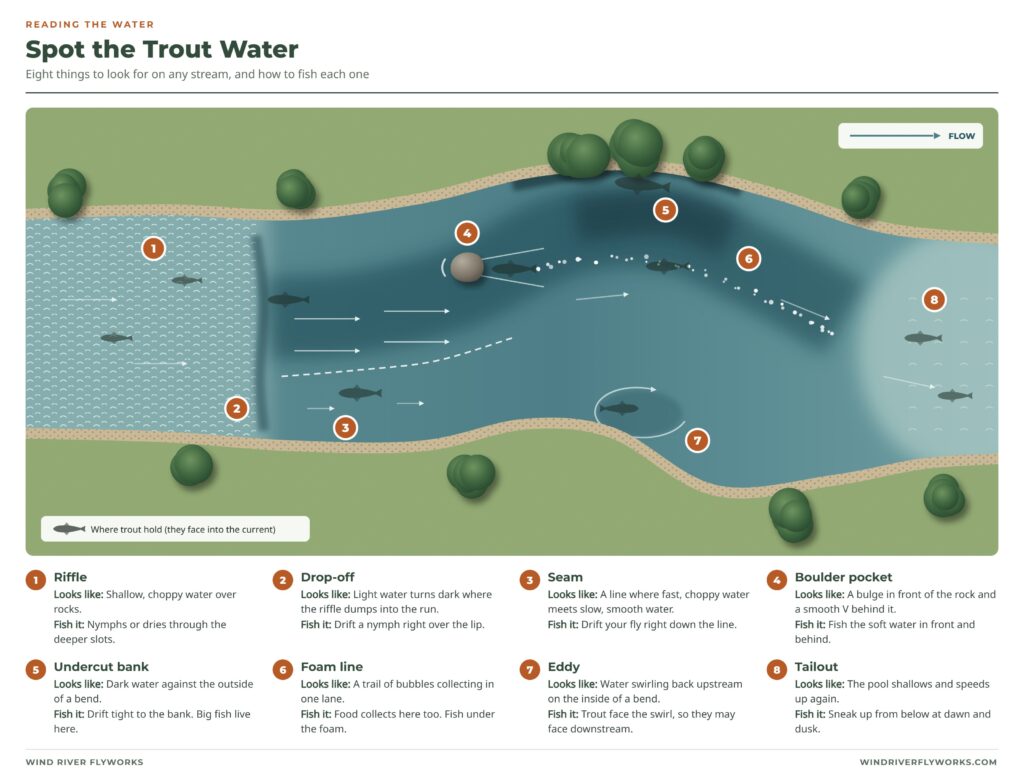
Trout want three things: food that comes to them, a place to rest out of the strongest current, and cover from predators. Every spot below gives them at least two of the three. The map shows all eight on one stretch of river, with what each one looks like and how to fish it.
Riffles: shallow and choppy, full of oxygen and insects. Fish the slightly deeper slots, especially in summer.
Drop-offs: where a riffle spills into deeper water. Trout sit just below the lip, waiting for food tumbling in.
Seams: the edge between fast and slow water. One of the most reliable places on any river.
Boulder pockets: the soft water in front of and behind a rock. Small pockets can hold surprisingly big fish.
Undercut banks: dark water against the outside of a bend, with shade and cover. Often home to the biggest trout in the stretch.
Foam lines: bubbles collect where the current gathers food. Put your fly right in the foam.
Eddies: water circling back upstream on the inside of a bend. Trout face into the swirl, so they may be facing downstream.
Tailouts: where a pool shallows and speeds up again. Fish move up into tailouts at dawn and dusk.
Six Surface Clues
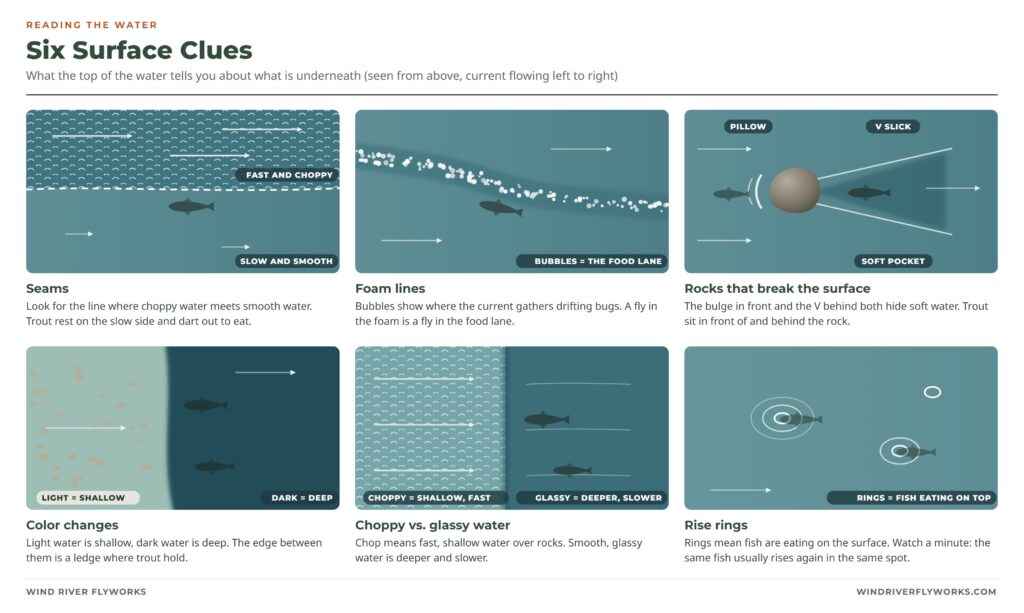
You can’t always see the bottom, but the surface gives a lot away. Once you learn these six clues, you’ll start reading water from fifty yards away.
A few things to remember about these clues:
Smooth water next to choppy water almost always means a seam. Drift your fly right down the line between them.
A rock that breaks the surface makes a bulge (the pillow) in front and a smooth V behind. Both hold fish. So does a rock you can’t see: watch for a boil or bulge on the surface.
Color changes mark depth changes. The edge of a dark shelf next to lighter, shallow water is a classic holding spot.
Rise rings tell you to fish a dry fly. A bulge with no bubble often means trout are eating emergers just under the surface.
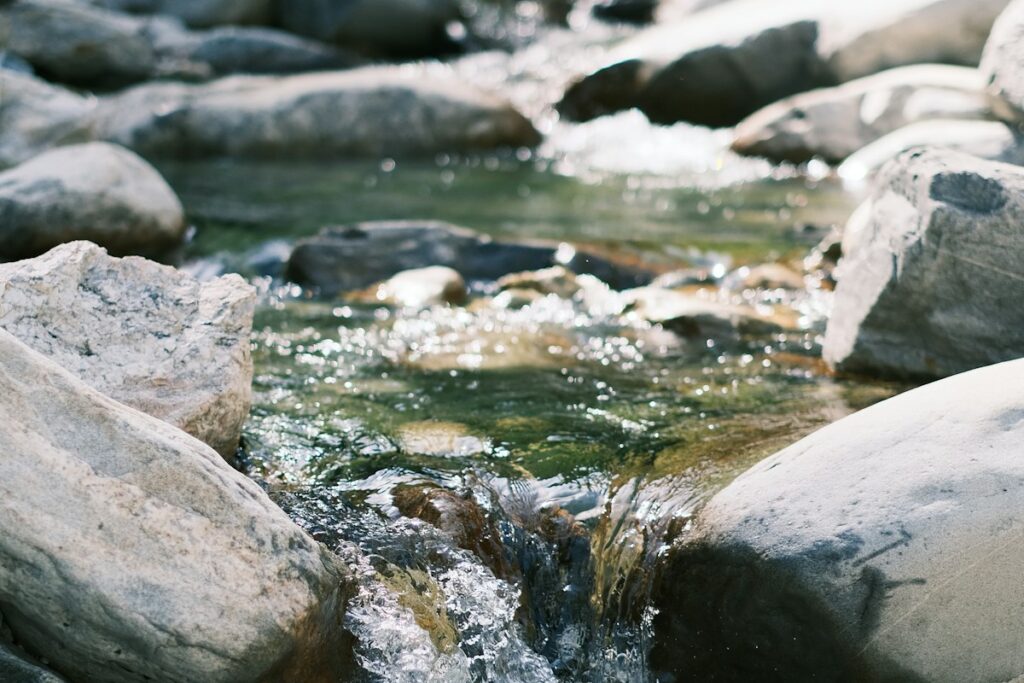
Pocket water: every soft spot around these rocks can hold a trout. Photo: May Cloud on Unsplash.
How to Work a Piece of Water
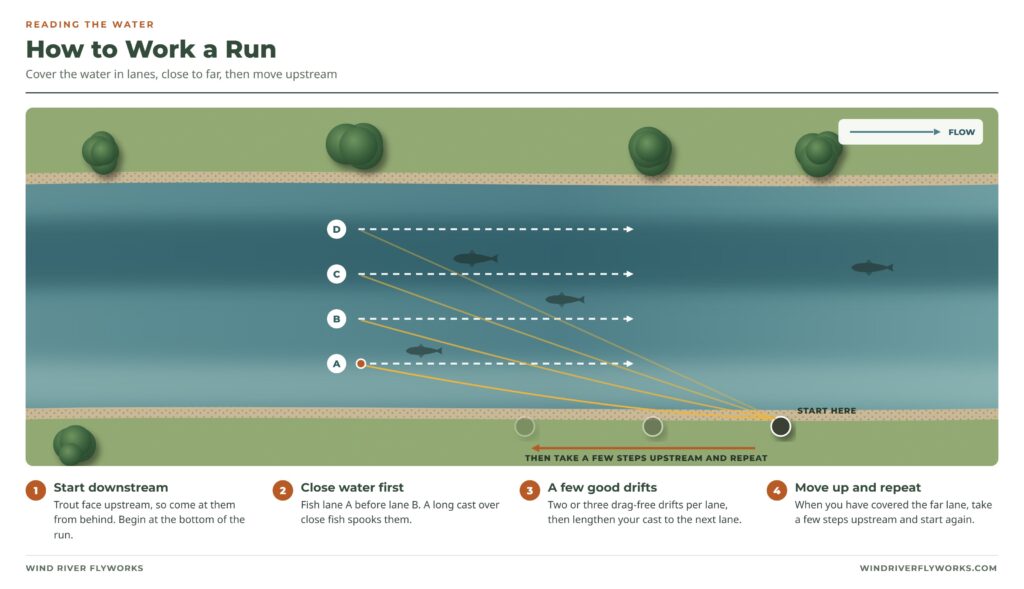
Finding the fish is half the job. The other half is getting a good drift to them before they know you’re there. Trout face upstream, so the best approach is almost always from downstream, behind them.
Start at the bottom. Begin at the tail of a run or pool and work your way up.
Fish the close water first. Cover the lane nearest you before you cast farther out. Casting a long line over close fish spooks them.
Give each lane a few good drifts. Two or three drag-free drifts is usually enough. Then lengthen your cast a foot or two for the next lane.
Move up and repeat. Once you’ve covered the far side, take a few steps upstream and start again close to you.
Wade slowly and quietly. Crunching gravel and pushing a wake ahead of you will clear out a run fast. Often the best fish is in water you were about to stand in.
Match the Method to the Water
Riffles: nymphs or a dry-dropper. The broken surface hides your leader, so you can get close.
Runs: indicator nymphing, or dry flies when fish are rising. Runs are the best all-day water on most rivers.
Pools: fish the head, where the riffle pours in, and the tail. Use heavier nymphs or streamers for the deep middle.
Pocket water: short casts and a high rod to keep line off the fast current. Hit each pocket a few times and move on.
Banks: hoppers and beetles in summer, streamers in fall. Land the fly tight to the bank.
Tailouts: dry flies and long, light leaders. The water is shallow and clear, so stay low and make your first cast count.
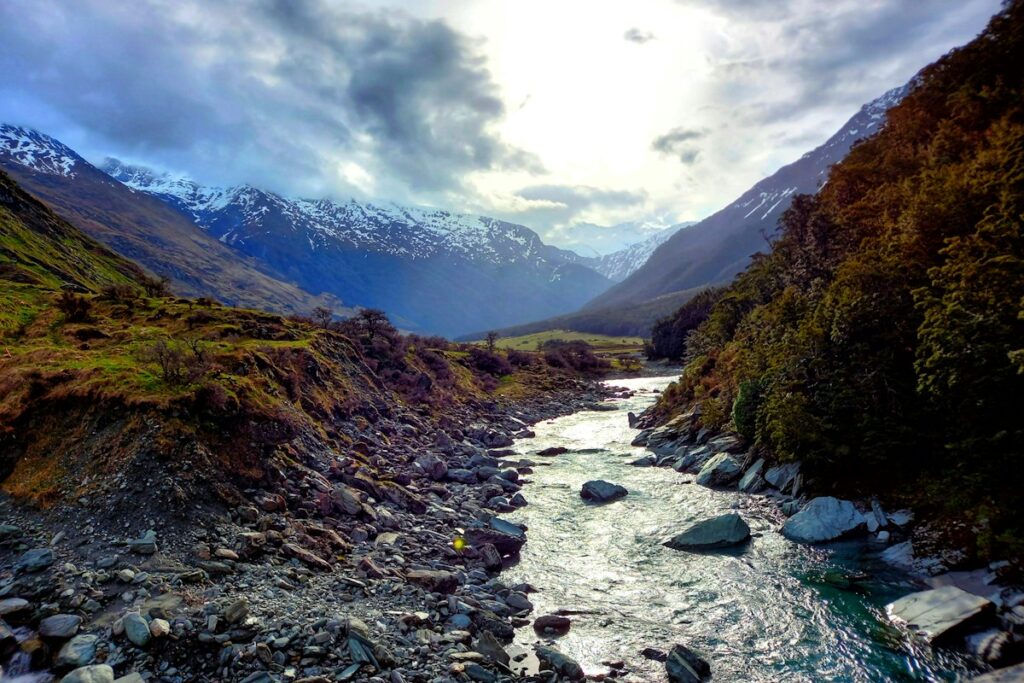
Big water is just a lot of small water. Break it into pieces and fish them one at a time. Photo: Courtney Maree on Unsplash.
Common Mistakes
Walking right up to the edge. Many trout feed in water only a foot or two deep, right at your feet.
Fishing only the deep, pretty pools. Pools hold fish, but riffles, pockets and seams often hold more feeding fish.
Casting too far. A short, accurate cast with a good drift beats a long cast with drag every time.
Staying too long in one spot. If you’ve covered a piece of water well and nothing happens, move on. Covering water catches fish.